
Five years: ‘A football book travels around the world’

Felix Schneider painted the cover of the book.

A sporty ‘Servus’ to the big, wide football world!

Our project ‘A football book travels around the world’ is celebrating its fifth anniversary today. On the final day of the 2018 Men’s World Cup in Russia, patron Urs Meier handed it over to former professional and now successful coach Gernot Rohr.

Numerous football legends have since filled the pages of the book with life, enriching it with their personal stories, experiences and anecdotes. Lutz Pfannenstiel, Bjarne Goldbaek, Moritz Volz, Danni Karbassiyoon, Ryan Smith, Michael Lahoud, Kelly Conheeney, Nicole Baxter, Sabrina Flores, Brianna Pinto, Anson Dorrance, Madi Pry, Talia DellaPeruta: the once empty collection of pages now reads like a little museum of football. And more internationally scattered, football-enthusiastic authors will follow. Currently, the book is with Scottish international Christy Grimshaw in Milan.
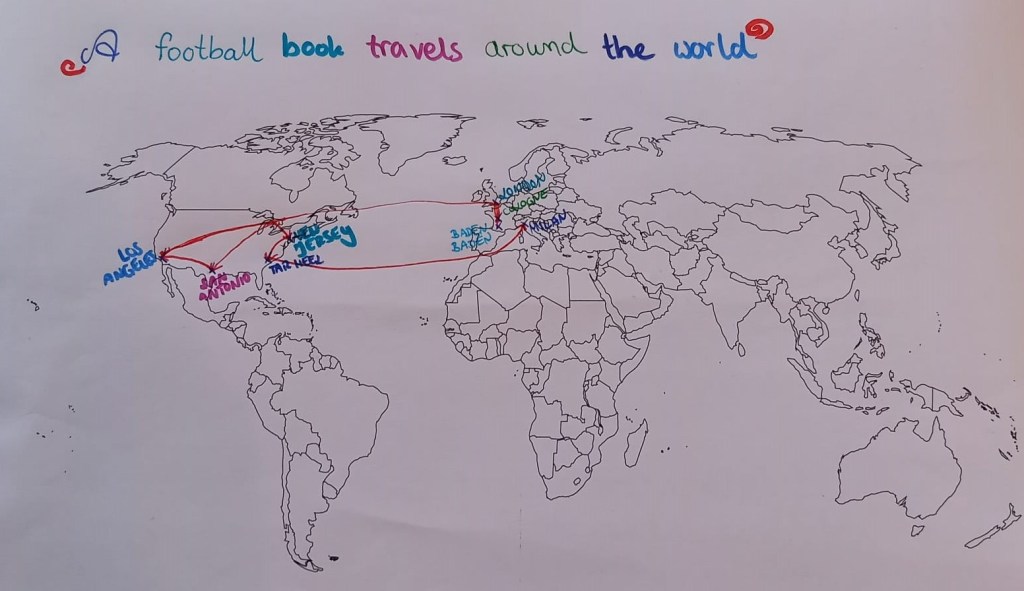
The football book has travelled a remarkable route so far. Photo: Lisa Schatz

About the project

In 2018, I had the idea of sending an empty book on a world tour, which people from the world of football should fill with their stories in their respective national languages. There are no limits to creativity. People are allowed to write, draw and make things. Only a maximum of three pages per person is required. The rules of the game are written in different languages on the first pages of the book. We welcome your own stories from the football pitches and stadiums, memories of special matches, football-related experiences, pictures, old newspaper articles, descriptions of social projects in football, opinions on football-specific issues, criticism (of course in line with the FAIR PLAY principle) and thoughts on how football unites people. Racist, sexist, homophobic, transphobic and fascist content is absolutely forbidden. In the end, a book is to be produced in which referees, coaches, players, fans, sports scientists, volunteers, sports journalists, fan project staff, sports psychologists, referees, managing directors of professional and amateur clubs from the most diverse leagues and countries have written in (a maximum of two per club).
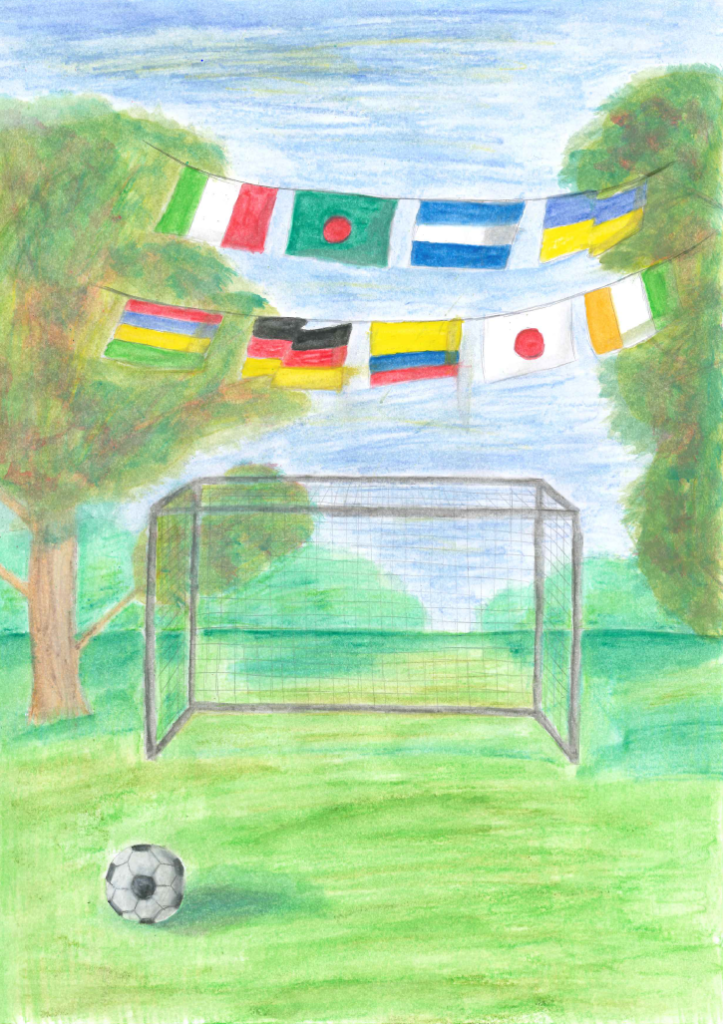
Johanna Busch designed the back of the book.

The cover and the back of the book were designed by Felix Schneider and Johanna Busch. The artists were arranged by Werner Müller. The „rules of the game“ for the book were formulated by myself. Carolina J. Mondi, Philippe Matic Arnauld des Lions, Jürgen Schreiner and I acted as translators.

The message of the book is as follows: football unites people. The central question is: „Can WE all, TOGETHER, manage to get such a project off the ground, which will WIDEL the TEAM spirit in football internationally?“ The exciting thing: Everyone who immortalises themselves in the book decides for themselves to whom they pass on or send the book. Thus, the route of the book is always a surprise.

Goal of the book: social purposes

If everything works out and if the book is finally filled up to the last page, the project initiator will look for companies/associations via her blog and presumably other media who would like to donate a sum of money in order to be able to display the book at their place for a certain period of time. The COMPLETE amount of money donated will then go to one or more social project(s) selected by the jury (consisting of Urs Meier, Armin Wolf and Lisa Schatz). The project ultimately only comes about if ALL work together.

Voices
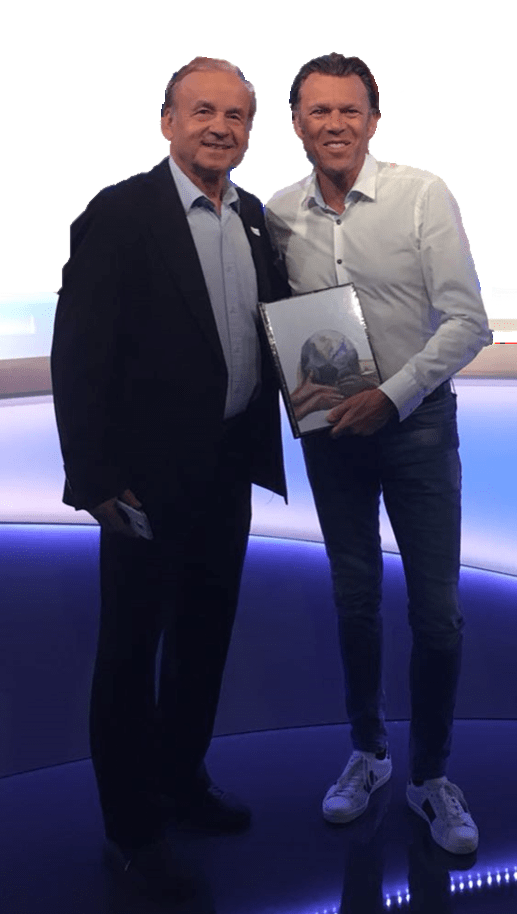
Urs Meier gives the football book to Gernot Rohr.
Photo: Urs Meier

Patron Urs Meier says: ‘I am incredibly convinced by the project. It connects people in football and, moreover, it is for a good cause. Above all, the book is supposed to travel around the world. I find that mega exciting. That’s exactly what football is all about: this world-spanning, this partly unpredictable, predictable, foreseeable thing. That’s exactly what the book embodies. Ultimately, it should stand for what football stands for: For openness in all areas of life – towards other cultures, other skin colours, religions. It should stand for fair play and for thinking differently – that we don’t forget the weak who are not lucky enough to be able to practise this wonderful hobby, that we also support them with this action. That’s what the book stands for.’ But he also criticises: ‘Now the book has been on the way for five years. Of course, I would have liked it if it had been finished much faster, if it had always been passed on much faster. Unfortunately, that is not the case. That is also part of our society, of people. That one or the other is not so reliable. Nevertheless, I hope that the book will be full of many wonderful stories. It’s nice to be able to hear such stories again and again. Often they are ones that no one has heard before, that have never been in the media or in a book. That these are really very personal, great stories. I’m happy when it comes back and when it’s finished. I hope that we will then be able to experience a happy ending together.’

Madi Pry.
Photo: UNC Athletics Communication

Former TarHeels player Madi Pry explains: ‘I decided to be part of the football book project team because if one person read my story and was able to relate to it or be inspired by even just one part of it, then it would be worth it. My soccer story involved lots of injuries and set backs and I know many others do too, so I wanted to add my story to the book in hopes to make someone else who has dealt with adversity feel seen and heard.’

Anson Dorrance describes: ‘First of all, I absolutely loved it for all kinds of reasons. I am a globalist. So for me, one of the many things I love about our game is the fact that it is a global sport. And so to see how we are all connected through our connections of love for the game is a part of the reason I absolutely love what I do. And another thing that was really cool for me, was to connect with the person who gave me the book [Madi Pry]. When she gave it to me, obviously I had no issue jumping in with both feet because she was a very special player for me and a very special person. So for all of those reasons, it is all about connection. What is important for me? It is important for me how this connects all of us. That’s what I like most about this project, is it literally connects all of us. It’s not one country, it’s multi-national and there are so many good things about being multi-national. I am a globalist, I was born and raised all over the world. I was born and raised in Bombay, India: lived there for three years, moved to Calcutta, lived there for three years; Nairobi, Kenya: lived there for three years; Addis Ababa, Ethiopia: three years, Singapore, Malaysia: three years. Then my family moved to Brussels, Belgium. When we were there I was sent to a Swiss Boarding School. So I was born and raised all over the world and I have loved that. I have loved that part of my background. So for me, this project is almost so similar to my life story.’
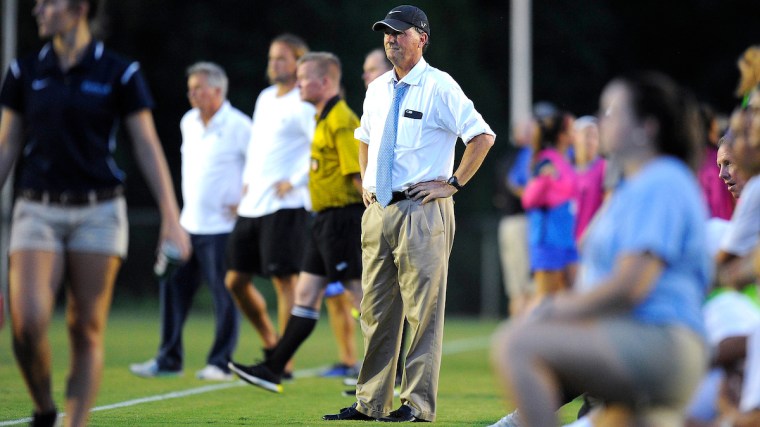
Anson Dorrance at work as Coach of the Tar Heels.
Photo: UNC Athletics Communication

The coach of the 1991 world champions adds: ‘Our world community is something that is going to stay alive partially through what you’ve done. So I thought that was very, very cool. I feel connected to everyone indirectly through the game.’ Furthermore, Anson Dorrance says: ‘One of the worst things about the global community is when we are in war with each other so I think this is almost like the antidote to a global community at war which is clearly what is happening right now between Russia and the Ukraine. So what’s the antidote? The anti-poison is a book like this that connects us, that does not separate us or cause us to go to war with each other. So for me, I think that is a wonderful way to frame it since – you are right – that was a period when Russia was embraced because they didn’t want war with anyone. So obviously the world had no issue going to Russia to compete. But now if they applied to host the event, they would never get it because of their behavior.’

Thanks!

Urs Meier and I with the football book. We are very happy about our team members. Photo: Lisa Schatz

I would especially like to thank all those who made it possible to start the project in this way. Above all, my thanks go to Johanna Busch and Felix Schneider, who designed the outer pages of the book – as well as to the translators Carolina Mondi, Philippe Matic Arnauld des Lions and Jürgen Schreiner. A big thank you goes to Werner Müller for putting me in touch with the two artists. Furthermore, I would like to thank Urs Meier for his great support of my crazy idea. Thanks also to Armin Wolf for his immediate agreement to participate in the jury. And of course thanks to all those who have already filled the book with content, which is really extremely diverse. The book shows how much football can weld people together and brings out highs as well as lows, exciting as well as poignant, impressive stories. I am honoured that we have so many personalities and different characters in the team. It is also worth mentioning that all team members are 100 per cent volunteers.

How the crazy project was born

The idea for the book came about relatively spontaneously. Shortly before a move, I gave a friend my friendship album to write in and my eye fell a little later on a children’s book by Dietmar Brück and Ulla Klopp about a ball that travels through different countries. Since I have been very football-mad for a long time, I wanted to start a project that shows how much football connects people and at the same time move something for a good cause. The whole thing only works if everyone really pulls together. I’m excited to see if it works.

Interviews and information around the book

Should you, dear readers, want to dive into some of the stories surrounding the football book, here is some info on the journey of the book as well as a few interviews:

Let’s be surprised which way the book will take next…!

Sportive regards

Lisa Blue

For reasons of better readability, the language forms male, female and diverse (m/f/d) are not used simultaneously. All personal terms apply equally to all genders.
Football book – Update no 6: From Ryan Smith to Michael Lahoud (English Version)

Dear football fans from all over the world,

As announced before, the football book has travelled from London to Texas. Michael Lahoud, former MLS player and Sierra Leonean international, has immortalized himself in it and answered my questions about the book, but above all about his life story… Read for yourself what wonderful experiences he could make through football…

Enjoy, take care and stay at home!

Lisa Blue


Interview with Michael Lahoud


Lisa: Hello Michael, Thank you very much for your time. It was so nice when I heard that the book went towards Texas and now we are talking with a time difference of seven hours. Football really connects people

Why did you want to take part in this project and what did Ryan tell you so that you wanted to take part in?

Michael: You know, I think what really interested me is – I am a big believer that things happen for a reason and that things are coming to your life at the right time. So, Ryan and I, we have been catching up and when he messaged me about the book, it came at the perfect time because I started reflecting back on my career. I started reflecting back on this season. And I really needed to be reminded of why I play this game. So it was just really the right time to be able to be given a blank canvas, to write something, to be a part of something, and really to give back to the game of football something that has given me so much. I want to give back so this story seems like a perfect opportunity.

What do you like most about the game? Is it about the connection of people from everywhere, is it the team feeling or what do you like?

It’s multi-fascinating, I absolutely love playing. It’s a place where you can dream in football or it’s a place where it doesn’t matter where you come from, your background doesn’t matter. Personally for me, football was the place where my background, my story, my socio-economic status doesn’t matter. In football age, race, nationality: It does not matter. We are all connected by football. And I think that I got to know there what really inspired me is anything that was given to me, anything that was taught to me, it has really started to inspire me to pass that knowledge on. I believe in young people, in young footballers. I used to be a young footballer and someone believed in me and so, whenever I get up there with young players and I see a little bit of myself in them, makes me that much more passionate about playing the game.

How hard was it? You have been a refugee when you came to the United States. Did you came on your own or with your family?

I came to the US as a refugee, I traveled by myself and I was awarded an emergency reason when I was six years old. I had no clue what was going on around me, but there is a tragic civil war going on in Sierra Leone at that time and that visa saved my life and football, really, saved my life. And when I came here, it didn’t know what was going on. I knew that I was going to come to reconnect with my family, my immediate family. But it was the best thing that probably could happen to me that I was too young to know anything. But I am very grateful for that visa, and that’s something I will never forget.

I imagine it must have been so hard because you were six years old, a little child…

Yes, it was difficult. It was hard enough when you go to somewhere new. The language is very difficult. English is spoken around the world but it’s unlike any other language. So I was learning English in school back in Africa. But what really made it difficult for me was, as a child, from Sierra Leone, we just grew up as Sierra Leonians. We never talked about what race you where, what you believe … It was really was we are just like all the same. And when I came to America… It was the first time that I felt different. And it was the first time it was hard done how different I was. So, I was so confused because I was like – God damn –  I have never experienced this before. And the easiest way to tell who you are if no one says it for you is: who you are not. So I just started noticing all the differences. That was very difficult for me.

Did you make experience with racism or how did you feel?

No, I lucked out. The first day I came to school in America, I met my best friend. Believe it or not: It was football that connected us.

That is really the power of football. It really unites the world. When I came to school, I was so afraid. A group of kids where playing football. Really, I wanted to be seen and I did not want to be seen because I hoped that no one sees me because I don’t know, I am the kid that’s different, that’s new. That is different. And of course, whenever you don’t want that you will be seen. The ball came to me, someone kicked the ball at a bounce. And the students said: ‘Hey, throw the ball.’ And I have never thrown a ball before, so I was very nervous. I did the one thing but I did not know how to do. I got the ball and I volleyed it back to them. And they have never seen that before. I volleyed it so hard and I kicked it over the roof of the building. I had the respect of everybody immediately. I was the kiddy who was new and nobody noticed. It didn’t hurt that the first person that came over to me was a most popular kid at school who said: ‘Hey, I have never seen anyone do that! You’re my new best friend.’ And he took me to his family. He was like: ‘Oh, this is my goalie, he can kick both – soccer balls, tennis balls – on the roof’. I could not believe it.

Did you get the chance to live in a family there because you were very young or was it like a refugee home?

My family was here. It was really interesting being in Sierra Leone and my family being here. I didn’t realize that I was so grateful for that. We all have family that is our blood. And we have the people become family to us. Because of that day it was like I was adopted.

He was like your brother…

Yes, really. It was really like I became part of them, it was offered this adopted family. They were so awesome to my biological family and they were so loving for me. My parents worked all the time. My mum, in particular, she’s a nurse, so it was really difficult for us trying to make sense of life here from where we came from. But my best friend, his name is Jack Wolf, I am forever grateful for what they meant to my family and I, over the years, what they made for me over the years.

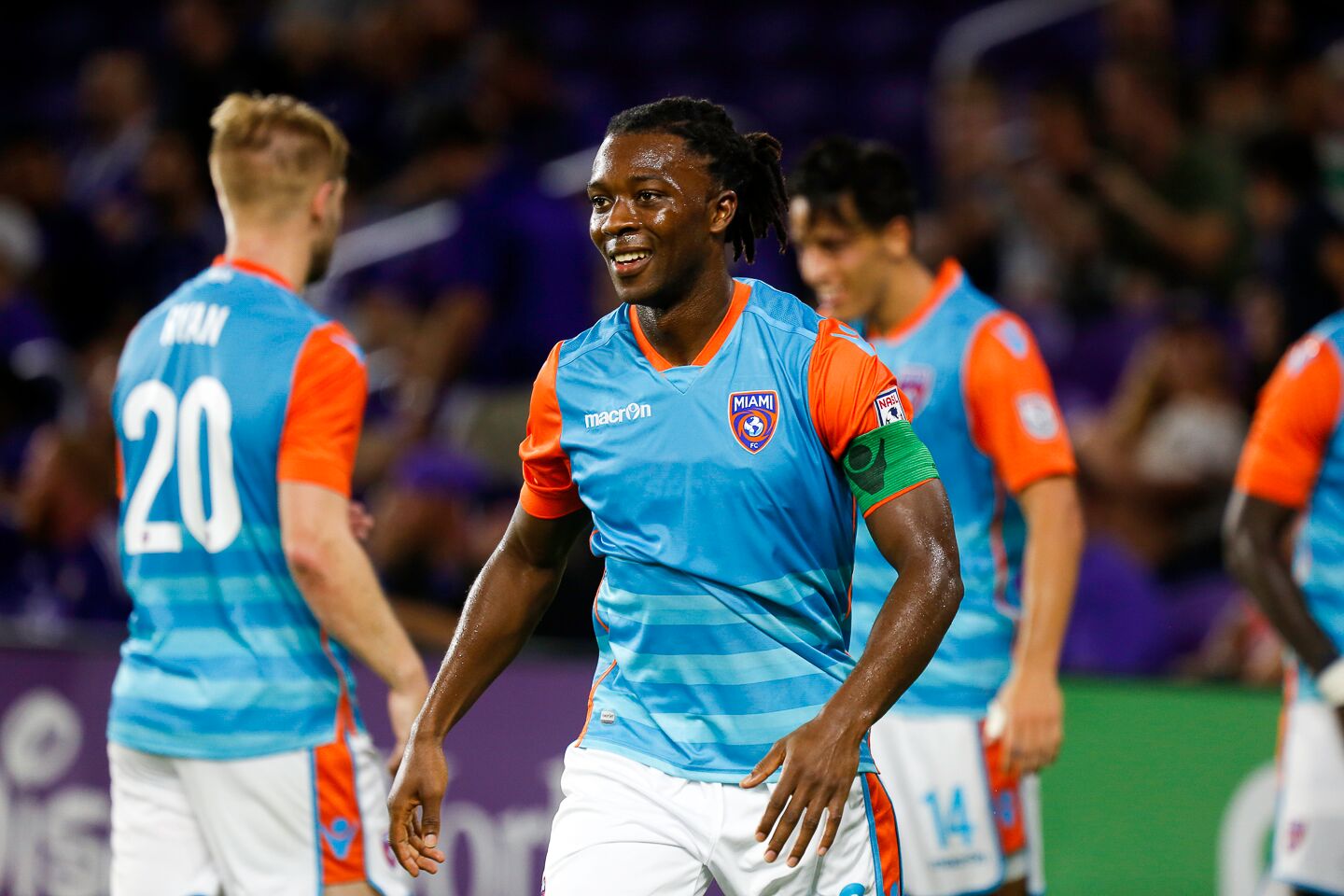
Michael Lahoud played for Miami FC. Photo: Alenny Orovio

In your story you wrote down into the football book, you wrote about the sports psychologist Dr. Cristina Fink. That she changed your life…

She was a part of my club at the time of the MLS (Major League Soccer). She was in Los Angeles. Here in Americas we do trades. It is similar to the basketball system. I am grateful that one trade allowed me to meet Dr. Cristina Fink. From the moment I met her, I knew that I need to work with her. It was never anything she said but she has this presence. I didn’t know her story or her background. She is a former Olympian, a high-jumper, from Mexico City. She is a very, very, very brilliant woman. I really knew that I wanted to get better. I wanted to be the best possible footballer I could be. I knew that I was given a talent. I knew my career could go places but I knew that talent wasn’t enough. I wanted help. There was a point where I needed help to get there and that was a very humbling experience. It was the first time in my career that I experienced not being the star. I experienced not being ‘the football player’ and that’s very humbling, if you experience it, when you get at professional sports. I think that adversity is the best thing that can happen to footballers, especially to young footballers. So, it was the right time for me to meet her and so, I was the only person in the team who was going to see her. Everyone, at that time, saying sports psychologists were not really like popular here, especially in America. But I did not really know who else was doing it but once she told me that this was a big thing throughout the rest of the world. And ‘in America, you guys are behind.’ And this aspect with sports, especially with football… That really helped me seeing that even the greatest of football stars, they needed help longer way to get there where they are. You can’t do it on your own. And so, it was just a perfect fit.

In what way did she help you at most?

Part of it was mental coaching but it never felt like coaching of any sorts. It just felt like someone who believed in me, who saw more in me that I could see. More than my talent. I think, every coach that I ever played for, saw, but could never put into words. She was the first person who could.

How old have you been when you met her the first time?

I was 26 years old. I was really haunted by this feeling of doing well is not enough. I have to kill it, I have to be the best of the best ever, I have to leave, everyone has to leave watching me with standing ovation. That’s not realistic. There is always someone who is better than you, who is better than you at something. Cristina didn’t try to take that away from me. She just gave me another perspective. She said: ‘Don’t lose that, and use another way of looking at it, use another way of motivating yourself. It’s not out there. It was always inside of you’. The most amazing things she said to me apart from playing for the love of the game was: ‘A good player doesn’t have to show that he is a good player. He just is one’. That stripped away that feeling of: ‘I need to prove, I need to prove, every day I need to prove,’ and really giving your validation to other people. Other people decide how you are doing. She said: ‘No. You know, a good footballer knows he is a good footballer. He hasn’t to tell the world, he has to know.’ In football, you have to fulfill your job.

It was those type of conversations that were so enlightening. In football, as much as to have talent, I would always think my way through. It came so naturally to me that I would – you know, in my head, I prepared the match as a young boy. At university, neither as a pro, I would get my mind ready and so to be on the work with someone who helped say: ‘Hey, here are some things that you are doing that will help you.’ And, ‘here are some ways that you can actually use to develop your mind to the next level.’ It’s really an incredible experience.

Did you have an idol like Zizou or did you just try to believe in yourself and try what you could?

Yeah, absolutely. Zinedine Zidane was never my idol, I thought he was an amazing footballer. It wasn’t just the class of what he played. He almost played of an elegance that he was so good. And he knew it. And you knew it. But it was that he knew it. And he wanted you to know it. My idol was David Beckham. He was someone who showed me that you can be more than football. For him, it was the commercial aspect of things. But he was the modern-day footballer who did really take that to another level: That you can be more than football. And this means something different for everyone else. For him, it’s the fame. He is also a family man. You can actually be a footballer but you can still be more than football.

Additionally, I would like to ask you about your social engagement. What projects do you do for social purposes?

It is something that has become a passion along with football. In 2010, I met a woman who asked me a question which changed my life. She asked me: ‘How would you like to change the world?’ And I was just started on my career and I was never expecting anyone who was asking me that if it didn’t have to do with football. I answered: ‘Oh, I change the world with football, being an amazing footballer’. But it really invited me into, you know, that the world is bigger than just me. And there is a social currency that runs deeper than just what I see. It’s bigger than just me. It captured my heart in a way that I knew. That I would change, and I would never be the same. That question she asked me, invited me in a process of self-discovery. It has expended my mind. I really wanted to use football, rather than just that means it is from my own game. To use football as a platform to benefit others. When you are a footballer and you play every weekend – yes, you play for your own passions and your own desires – but you are only a professional because the fans pay to watch you play. Without the fans you’re just – you’re an amateur. What it means to be a part of the team, play for that badge: You play for a tradition that is bigger than you. The players that make the greatest impact in the game, they embody that, they take that on, this means more to them. That message of this means more. My life, my story, my career…It means more. And I really want to use that to impact my home country, my native country of Sierra Leone. Her question invited me of finding out more. Not just about who I am, but where I come from. It helped me to recover a part of me because of Civil War and moving to America. So I like to use my platform as a footballer to make sure that this war in Sierra Leone never happens again. I want to help the children to make sure that this never happens again.

She was helping my country to build schools in my home country. She is a former Peace Corp member. I could not believe the timing. I never had a person whose timing was that impactable to enter my life and enter my eyes.

What did you do?

I started up on a journey. I really wanted to build a school in my hometown in Sierra Leone. In five years, we did this along with my Sierra Leone national team-teammates; we partnered to build a school. That’s something I will forever be proud of. Along the way to that process, awful things were happening in that country; Cholera broke out in 2014; a friend of mine from Heidelberg and I, we teamed out to raise money for ‘Doctors Without Borders,’ and we created this campaign called ‘Kick Ebola in the butt’. People really liked it: They supported the cause and they supported the school. It is amazing what playing for something and using a sport that brings people that would have otherwise never been connected together – when you use that for a cause that is bigger than yourself, for a common cause, it’s amazing, the power of football. I think that encapsulated the power of football. Now, we are looking to take that school to the next level by really incorporating playing football. For these kids, we built a football pitch at a school. It is incredible power for them, also for the people in the neighborhood. It is a moment that I will never forget seeing the kids you are impacting and the gratitude.

Thank you very much for these stories! Now, I would like to come back to the topic of the football book. Why did you decide to take part in our project?

I believe in stories. The most powerful thing about every one of us is our stories and the stories can’t say being written. Being able to go back to Sierra Leone and witness the story that was being written there, it made me so grateful for the people who supported me and encouraged me through the process in building that school. What I played for, or what might have been if I hadn’t, or stopped because there are people who are counting on me that I didn’t know, that I’ve never seen before half-way across the world; who are counting on me to keep their dream alive and to see those people saying ‘Thank you! Because of your dream, we have a chance in life.’ When I think about seeing those kids, that’s what really touches me and I always remember.

We do live in a world of excellence and luxury. If I could give just one wish to other Americans, it would be the ability to travel the world. In Europe, you guys travel so much. Here in America, because the country is so big, a lot of people do not travel so much. Everybody should try to get other perspectives. We need each other, as humans, not just our neighbors.

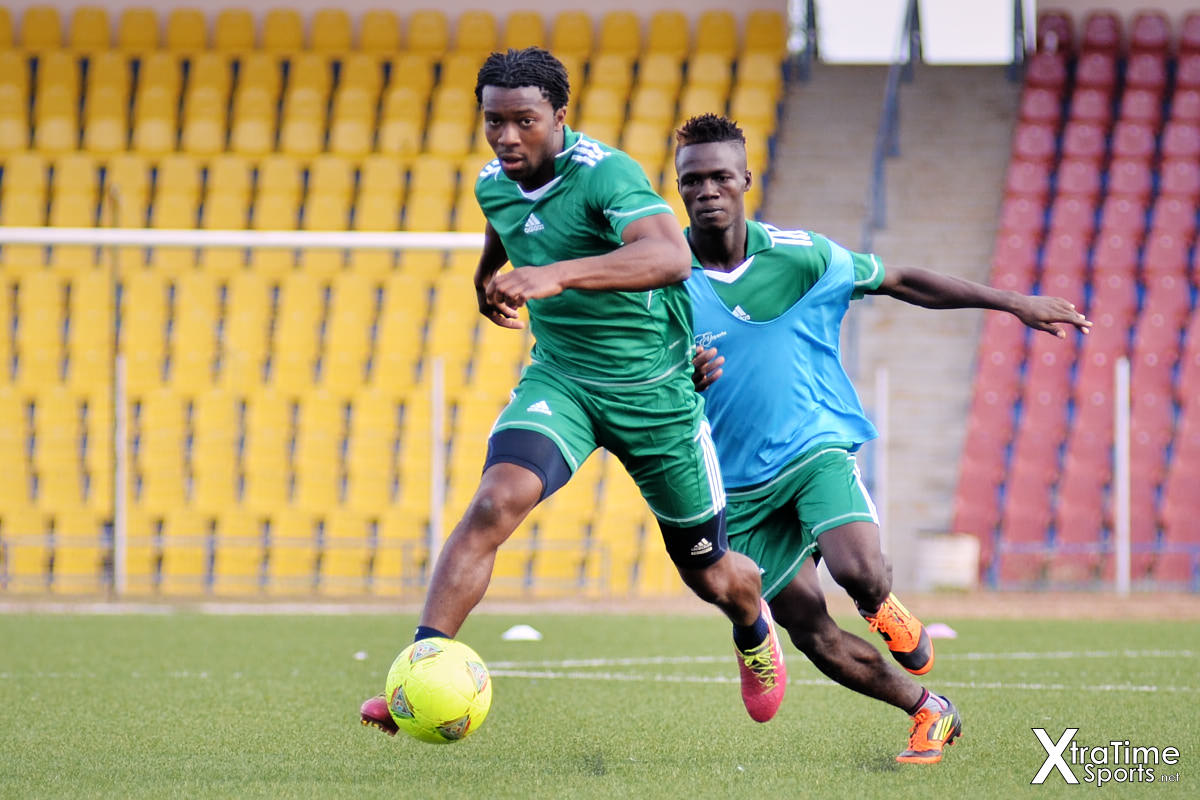
Sierra Leone training camp ahead of Swaziland v Sierra Leone on 18 May 2014. Lobamba, Swaziland.
Michael Lahoud at the international match against Swaziland on May 18, 2014. Photo © www.XtraTimeSports.net / Darren McKinstry

When would the book be successful in your eyes?

It feels such an honor to be a part of this book because we all have stories as I said, and even as footballers, people think that everything is just ‘perfect’. They only see you from outside and there is much more to footballers, and human beings, as well. We have struggles, we have moments that change our lives. To be able to invite other people into our stories, it’s really an intimate experience of this book and I can really see it taking it off. I am really excited to go back and read stories. Go back and read my own story with a different perspective, in a few years. I think it’s a special project and it reminds us to be human. When I say that, for me, humanity, there is a sense of stories. The power of stories. That is something that we never lose. That stories make us human.

Thanks a lot for all the great impressions, Mike.

You’re welcome.